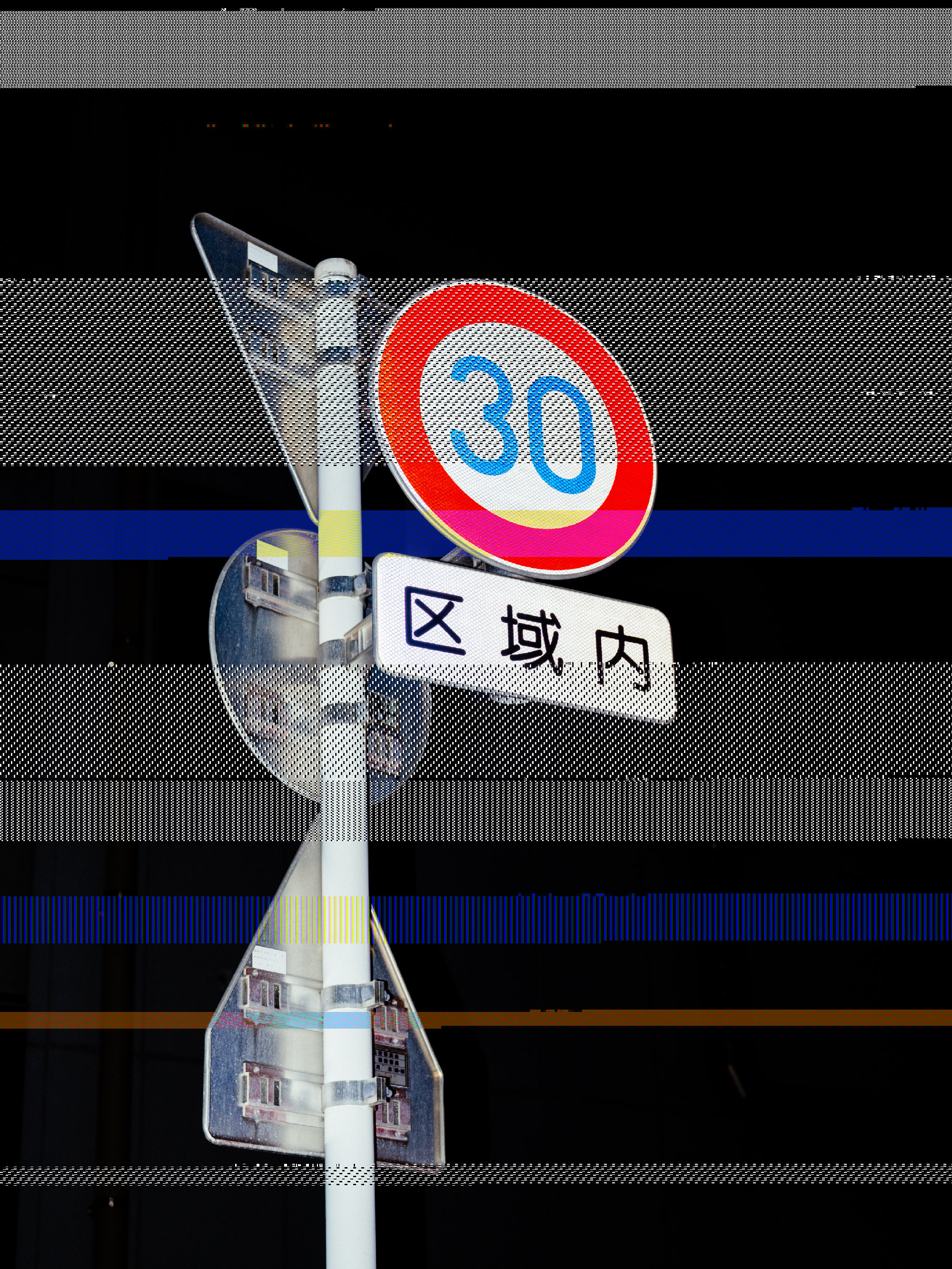
Sign and Matter
When you’re driving, you read a sign in an instant. 30. Stop. Road closed. The moment you see it, you take only the meaning and drive on safely. But you don’t register the state the sign is in. What its surface looks like, how the post has worn—normally no one pays attention to any of that.
If you don’t drive, a pedestrian signal might be the better example. Green or red, you check just that and cross. But what color was the housing, was there rust on the pole, what did the surface of the lamp look like—almost no one can say. You cross it every day, yet all you see is green or red.
This isn’t a matter of attentiveness. If you checked a sign down to its condition, you couldn’t drive at all. To read a sign in an instant, you discard the fine detail of it as matter and pull out only its meaning as a symbol. Reading it effortlessly is exactly what that discarding makes possible.
So ordinary perception runs on omission. By deliberately not seeing everything, we grasp the world in front of us quickly. Keep only the part you need, and treat the rest as if it weren’t there. Try to take in every last detail and life stops working.
But sometimes an element you’d erased from perception suddenly shows itself.
A sign whose reflective sheeting has lifted at the edge and begun to peel. A post still silver up top, but rusted brown only at the base where it meets the ground. One dented and leaning at an odd angle, as if a car had hit it.
When you see something like that, what’s in front of you isn’t just the information “30” or “Stop.” It’s peeling film, rusting metal, a structure set upright against the ground. The hidden elements rise into view.
What’s interesting is the order. As long as it reads smoothly, the material and the condition stay invisible. Only when reading it takes effort do they come into view.
Just as we treat signs and signals as symbols rather than matter, the same thing must happen all through daily life. Breaking, staining, tilting. Only when such a fray appears, I suspect, do we perceive the world in front of us anew.